
Noise complaints in HOAs are quite common. Associations try to regulate noise to minimize its negative effects on the community, but managing noise is trickier than boards think. It takes communication, proper enforcement, and a clear noise policy.
Understanding Noise Complaints in HOAs

Homeowners associations are admired for their convenience, wide range of amenities, and sense of community. Just like with any other neighborhood, associations also experience their fair share of noise complaints.
Condo associations, in particular, tend to have more noise problems than other types of associations. This is due to the close proximity in which residents live. Units typically share walls and hallways, allowing noise to travel more easily.
Associations consisting of single-family homes don’t have as many noise complaints as condos, but that isn’t to say they experience none at all. These communities can still have rowdy residents, noisy neighbors, and party people.
Thanks to the growing popularity of remote work, an increasing number of residents find themselves staying at home at all hours of the day. This has made noise issues more noticeable, leading to a higher number of complaints.
The Negative Effects of HOA Nuisance
Nuisances can impact both individual homeowners and the community as a whole. Noise remains the primary nuisance among associations, but nuisances can also take the form of foul odors, neglected homes, or generally disruptive behavior.
Here’s how nuisances can negatively affect associations and their residents.
1. Decreased Property Values
Persistent nuisances tend to make the neighborhood less appealing to buyers. Poorly maintained homes, loud noise, or unsightly conditions can deter potential buyers and reduce overall property values.
2. Strained Relationships
Conflicts often arise when nuisances are left unresolved. Disputes over noise, pets, or yard maintenance can escalate quickly. This creates tension and hostility between neighbors.
3. Lower Quality of Life
Living with nuisances, such as barking dogs, loud parties, or unpleasant smells, can have a huge impact on daily comfort. Homeowners may feel trapped or dissatisfied in their own homes.
4. Increased Conflict
Ongoing nuisances usually lead to more complaints from homeowners, resulting in more work for the board. This can put a strain on the association’s resources, delay other essential tasks, and slow down resolution.
5. Potential Legal Issues
When left unaddressed, nuisances can escalate, and homeowners may take legal action. This can result in costly lawsuits and other expenses for both homeowners and the association.
6. Damage to Reputation
Word travels fast, and a neighborhood with growing nuisance problems can quickly develop a bad reputation. This can discourage buyers, lower property values, and make it harder for the community to thrive.
Can You Complain to the HOA About a Neighbor?
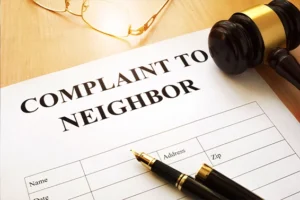
Yes, homeowners can generally file a complaint with their association about a noisy neighbor, especially if the latter is violating noise restrictions. Homeowners should check their association’s rules and formal complaint procedures. It is also a good idea to document proof of the violation.
That said, associations might encourage residents first to attempt resolution without board interference. Homeowners can approach their neighbor and ask them to lower their volume respectfully. Most of the time, neighbors will understand and comply with the request.
How to Handle Noise Complaints
Dealing with noise complaints is standard practice for many associations. Here are the best strategies to minimize, control, and penalize noise within the community.
1. Develop Noise Restrictions
First, associations should create noise rules, such as quiet hours and acceptable noise levels. Quiet hours usually fall between 9 p.m. and 8 a.m., giving residents an undisturbed time to rest.
Boards should make sure these rules and restrictions are outlined in the governing documents. If not, the board’s authority to enforce these rules may be challenged.
2. Establish a Formal Complaint Procedure
A formal complaint process helps standardize all concerns and create a paper trail. This ensures consistency and transparency in enforcement. Boards should clearly indicate the steps for filing complaints and submitting supporting documentation.
3. Apply Penalties for Violations
Associations should enact and implement penalties for noise violations. Common penalties include monetary fines and temporary suspension of privileges.
In Virginia, associations have the power to enforce these penalties if their governing documents reflect them (Section 55.1-1819). Associations must first provide notice of the violation and allow the homeowner to be heard before taking enforcement action.
4. Communicate
Residents must understand their association’s noise rules and any penalties they may face for violating them. As a gentle reminder, boards can occasionally include these rules in the newsletter or other communications.
5. Adopt Dispute Resolution
If the situation escalates, associations must consider dispute resolution. Most communities have internal resolution procedures, but alternative dispute resolution is also an option.
Understanding Local Noise Ordinances
There is no statewide noise ordinance in Virginia. Noise rules are primarily set at the local level, with each city or county establishing its noise ordinances.
That said, state law (Section 15.2-980) limits civil fines to $250 for a first offense and up to $500 for subsequent offenses. This applies to local governments.
How to File a Noise Complaint
A resident’s first course of action should be to talk to their noisy neighbor. It is advisable to attempt to resolve the complaint directly before escalating to local authorities or the association. If that does not work, the resident may refer to the complaint procedures below.
How to File Noise Complaints With Local Authorities
For decibel-based or recurring noise, such as construction, residents may contact their local code compliance department. For plainly audible noise or violations of quiet hours, residents may contact the local police department’s non-emergency line.
Residents must give a clear description of the noise, including the type and source of the noise. They must also provide the exact location or address, time, date, and duration of the noise. Other pertinent details include witnesses, recurring patterns, and the complainant’s contact information.
How to File HOA Noise Complaints
For violations of noise rules, residents may refer to their association’s complaint procedure. This typically involves submitting a form or calling a hotline. The association board or community manager generally handles noise complaints.
As with local noise complaints, residents must also provide key information about the noise to the association. This includes the date, time, and location of the noise. Some associations may ask for supporting evidence.
The Right Way to Deal With Noise
Noise is a growing concern among homeowners associations, so boards must learn how to manage related complaints effectively. Adopting clear rules and a standard enforcement process is imperative in handling noise issues and keeping residents satisfied.
National Realty Partners is a leading provider of association management services in Virginia. We can help your board manage noise complaints. Call us today at 703-435-3800 or request a proposal online to get started!
RELATED ARTICLES:
- Meet The HOA Board: Roles, Responsibilities, And Duties
- What Is a Homeowners Association? Understanding The Basics
- Crossing The Line: Unenforceable HOA Rules In Virginia